
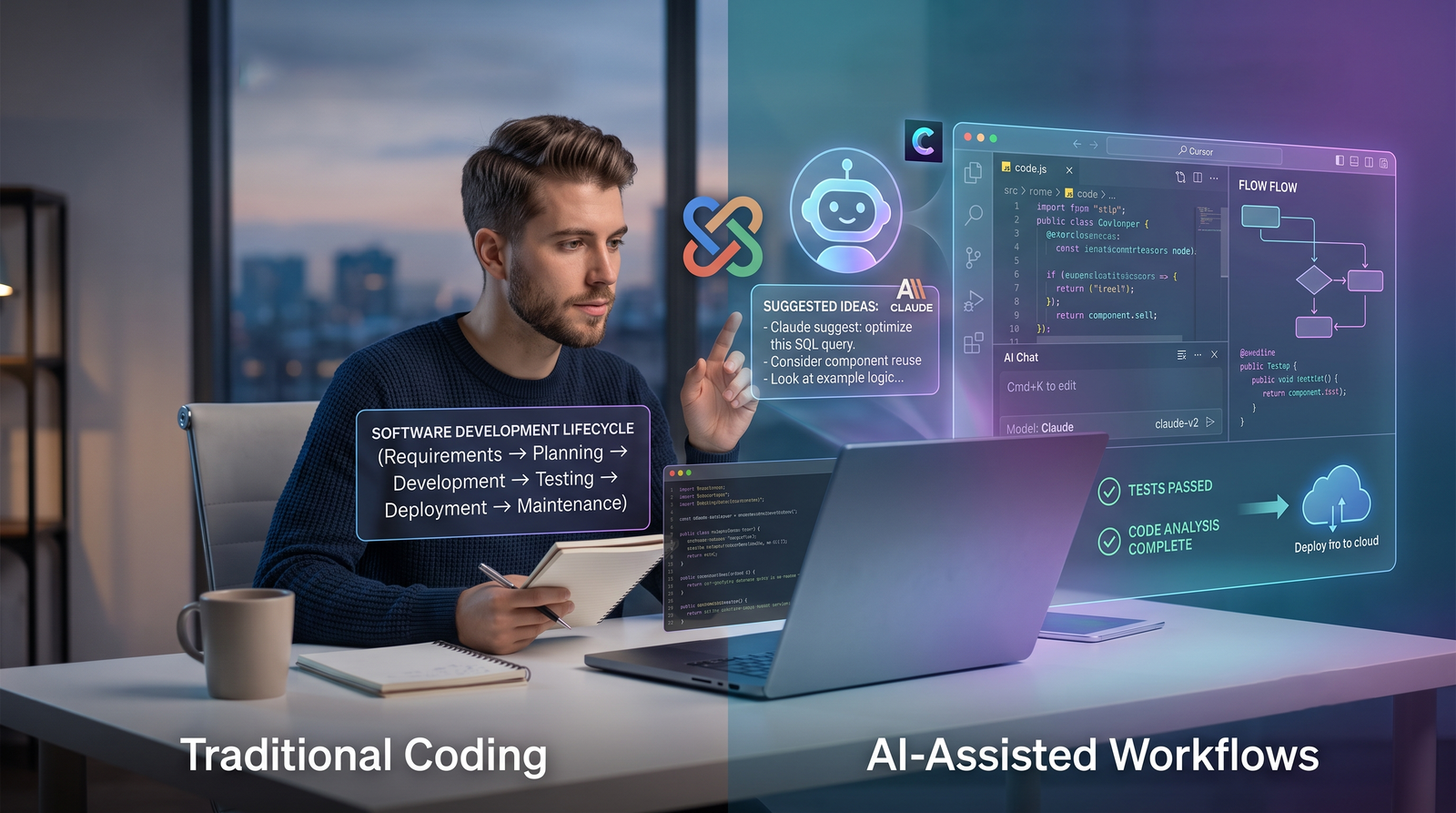
Every few years, the technology industry discovers a new buzzword. We have lived through the era of cloud computing, blockchain, cryptocurrency, NFTs, the metaverse, and now Artificial Intelligence.
If you open LinkedIn today, it almost feels like every second post contains the words AI-powered, AI-driven, or AI-first. Some people believe AI will replace every developer in the next few years, while others dismiss it as just another trend.
Personally, I think both sides are wrong.
As someone who spends most of my day building web applications, I don't see AI as a magical replacement for software developers. Instead, I see it as the biggest productivity tool our industry has received in decades.
The future of AI isn't about replacing developers.
It's about changing how we build software.
We've Seen This Story Before
When PHP frameworks like Laravel became popular, many developers feared that writing raw PHP would disappear.
When Git became the standard, people thought version control had become "too complicated."
When Docker entered the picture, many developers avoided it because it looked overwhelming.
Today, we can't imagine professional development without these tools.
AI is following the same pattern.
Initially, people focus on the hype. Eventually, the technology becomes so integrated into our workflow that we stop talking about it altogether.
Nobody says,
I built this application using Git.
Git is simply expected.
One day, AI will be just as normal.
AI Through the Web Development Lifecycle
Instead of discussing futuristic robots, let's look at something every web developer understands—the Software Development Lifecycle (SDLC).
This is where AI is already making a real difference.
1. Requirement Gathering
Every project starts with understanding what the client actually wants.
And let's be honest...
Clients rarely explain everything clearly.
Sometimes we receive a message like:
I need an admin panel with reports.
That single sentence could mean hundreds of different features.
Today, AI helps me convert vague client discussions into structured requirement documents.
I can paste meeting notes into an AI assistant and ask questions like:
What requirements are missing?
What edge cases should I clarify?
Which user roles have not been defined?
Instead of replacing conversations with clients, AI helps me ask better questions.
That's an important distinction.
Good software still begins with understanding people.
2. Planning and Architecture
Once requirements are ready, we start thinking about architecture.
Should this be a monolithic application?
Should we separate services?
How should the database be designed?
Earlier, this research could take hours.
Today, AI becomes a brainstorming partner.
For example, if I'm designing a school management system, I can ask AI:
Suggest a scalable database structure for handling students, teachers, attendance, exams, fees, and multiple schools.
I don't copy the answer blindly.
Instead, I evaluate it, improve it, and adapt it to my project.
AI accelerates thinking.
It doesn't replace engineering judgment.
3. Development
This is where most people think AI will replace developers.
From my experience...
Not even close.
Yes, AI can generate code.
Sometimes it writes beautiful code.
Sometimes it writes code that looks impressive but quietly introduces security issues, unnecessary complexity, or performance problems.
Imagine asking AI:
Build a login system.
Within seconds, you'll get working code.
But is it secure?
Does it protect against session hijacking?
Does it handle password resets?
Does it implement rate limiting?
Does it meet your company's architecture?
That's where experience still matters.
I often compare AI-generated code to a junior developer's first draft.
It's useful.
But it still needs review.
4. Debugging
This is probably where AI saves me the most time.
We've all experienced that frustrating moment:
Everything looks correct.
No syntax errors.
No obvious mistakes.
Yet the application refuses to work.
Previously, debugging could consume hours.
Now I can paste the error, explain the project context, and AI often points me toward the actual problem much faster.
Recently, while working on Docker configuration, AI helped identify a networking issue that would have taken considerably longer to isolate manually.
Did AI solve everything?
No.
But it reduced the investigation time dramatically.
5. Documentation
Let's be honest.
Most developers enjoy building software.
Very few enjoy documenting it.
Yet documentation is essential.
AI can generate API documentation, README files, installation guides, and deployment instructions from existing code.
Instead of starting with a blank page, I start with a solid draft.
Then I edit it to reflect the actual implementation.
Documentation becomes faster instead of becoming an afterthought.
Where AI Still Struggles
Despite all the excitement, AI still has significant limitations.
It doesn't understand business politics.
It doesn't attend client meetings.
It doesn't negotiate priorities.
It doesn't understand your company's long-term vision.
It also lacks accountability.
If AI generates poor code, the responsibility still belongs to the developer who ships it.
That's why I don't think companies are hiring fewer developers because of AI.
Instead, they're expecting developers to deliver more value in the same amount of time.
The Real Skill of the Future
Many people ask,
"Should I learn AI?"
I think that's the wrong question.
The better question is:
Can I work effectively with AI?
Knowing how to ask the right questions is becoming as valuable as knowing the right syntax.
A developer who can clearly describe a problem, verify AI-generated solutions, and integrate them into a production system will always outperform someone who either blindly trusts AI or refuses to use it altogether.
The future belongs to developers who combine engineering fundamentals with AI-assisted productivity.
My Perspective
If someone asked me whether AI will replace web developers, my answer would be simple.
No.
But developers who effectively use AI will likely outperform those who don't.
Just as calculators didn't eliminate mathematicians and IDEs didn't eliminate programmers, AI won't eliminate software development.
It will redefine what being a good developer means.
The future of AI isn't about machines taking over.
It's about humans spending less time on repetitive work and more time solving meaningful problems.
And if that future allows us to build better software, learn faster, and spend more time thinking instead of typing, then perhaps the hype isn't entirely misplaced.
The real revolution isn't that AI can write code.
The real revolution is that it allows developers to focus on what truly matters—understanding problems and creating solutions that improve people's lives.
Comments (4)
Want to join the conversation?
Log in or create a ShubhamLabs account to leave a comment.