
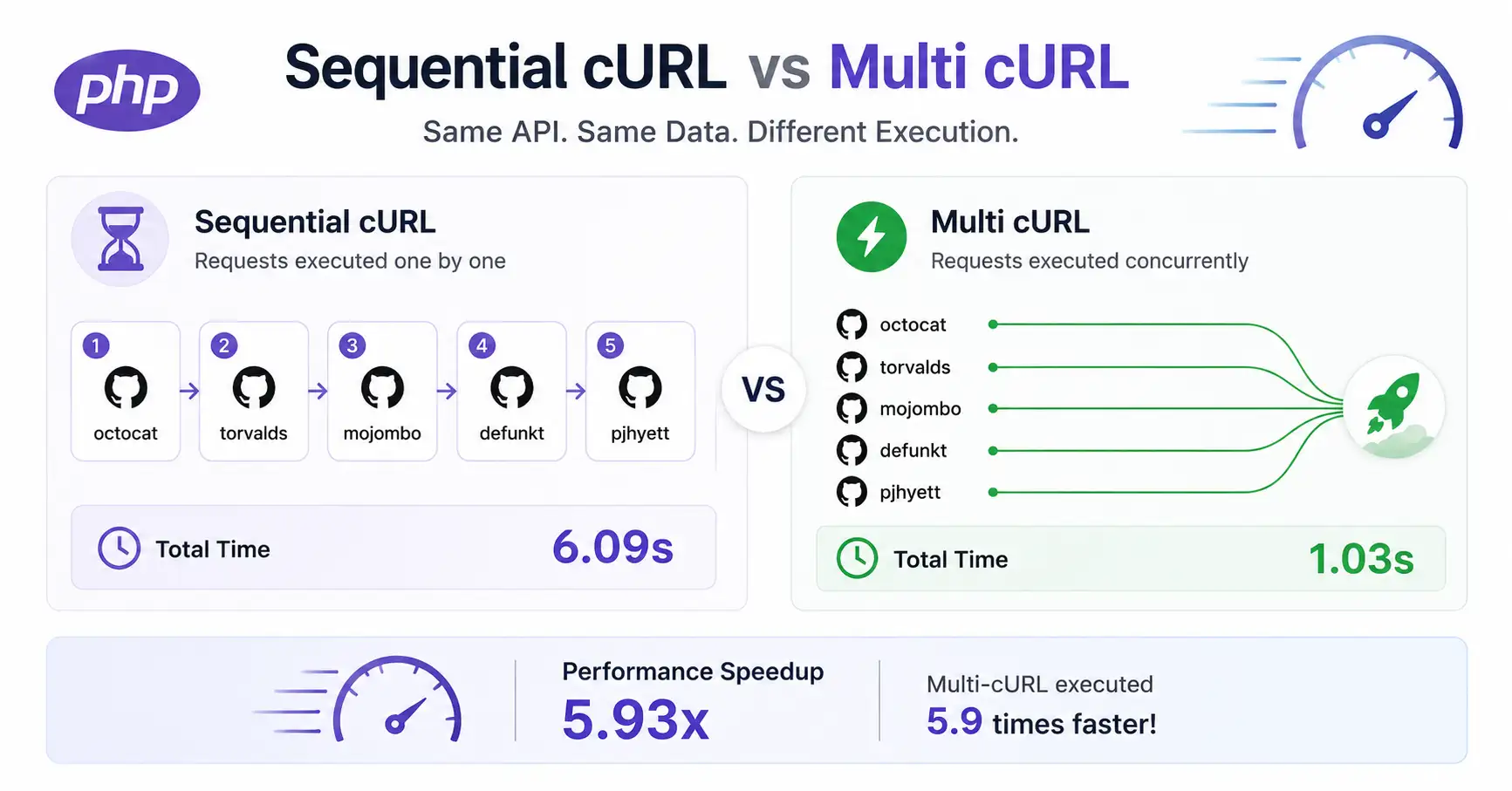
If you've been developing web applications for a while, you've probably come across this advice more than once:
"Use Multi cURL. It's much faster than normal cURL."
But have you ever stopped and asked yourself why?
Not how to use it, but why it actually makes a difference.
Let's understand that with a practical example.
A Real-World Problem
Imagine you're building an e-commerce product page.
To display a single product, your backend needs data from multiple services:
Product details
Customer reviews
Inventory status
Recommended products
Shipping information
Now here's a question.
Do these APIs depend on each other?
No.
The product details don't need to wait for customer reviews.
The inventory service doesn't care whether the recommendation service has finished.
They're all independent requests.
So why should your application wait for one request to finish before starting the next?
The Traditional Approach
Many developers unknowingly write code like this:
$product = getProduct();
$reviews = getReviews();
$inventory = getInventory();
$recommendations = getRecommendations();
$shipping = getShipping();
At first glance, nothing looks wrong.
But here's what's happening behind the scenes.
Request Product
      ↓
Wait for response
      ↓
Request Reviews
      ↓
Wait for response
      ↓
Request Inventory
      ↓
Wait for response
      ↓
...
Your application spends most of its time doing one thing.
Waiting.
If every API takes around 300 milliseconds, then five requests could easily take around 1.5 seconds before the page is ready.
Thinking Differently
Now ask yourself another question.
What if all these requests started at the same time?
Instead of this:
A → Finish
B → Finish
C → Finish
D → Finish
E → Finish
You do this:
A ───────────────┐
B ───────────────┤
C ───────────────┤
D ───────────────┤
E ───────────────┘
Now every service is working simultaneously.
Your application simply waits until all responses are available.
The APIs aren't faster.
They're just no longer waiting for each other.
This is the core idea behind concurrency.
So Where Does Multi cURL Come In?
PHP's Multi cURL allows you to manage multiple HTTP requests together.
Instead of creating one request, waiting for it to finish, and then creating the next, Multi cURL starts multiple requests and monitors them simultaneously.
Think of it this way.
Imagine you're ordering food for five people.
Would you place one order...
Wait until it's delivered...
Then place the second order?
Of course not.
You place all five orders together.
The restaurants prepare the food independently, and you simply wait for all of them to arrive.
That's exactly how Multi cURL works.
A Common Misconception
Many developers believe Multi cURL makes APIs faster.
It doesn't.
If server takes 400 ms to return a response, it'll still take around 400 ms.
The improvement comes from reducing idle waiting time inside your application.
Instead of waiting five separate times, you wait once.
That difference becomes significant as the number of independent requests increases.
When Should You Use It?
Multi cURL is a great choice when you're working with independent API requests, such as:
Fetching multiple GitHub users
Loading product information from different services
Calling multiple microservices
Aggregating data from third-party APIs
Building dashboards with multiple widgets
If one request doesn't rely on another, it's usually a good candidate for concurrent execution.
When You Shouldn't Use It
Not every workflow can run concurrently.
Imagine this sequence:
Create an order.
Receive the Order ID.
Generate an invoice using that Order ID.
Create a shipment for that invoice.
Each step depends on the previous one.
Here, sequential execution is the correct approach.
Concurrency is about removing unnecessary waiting—not ignoring business logic.
Learning Through a Practical Project
While learning this concept, I didn't want to rely only on articles or benchmark charts.
I wanted to see the difference myself.
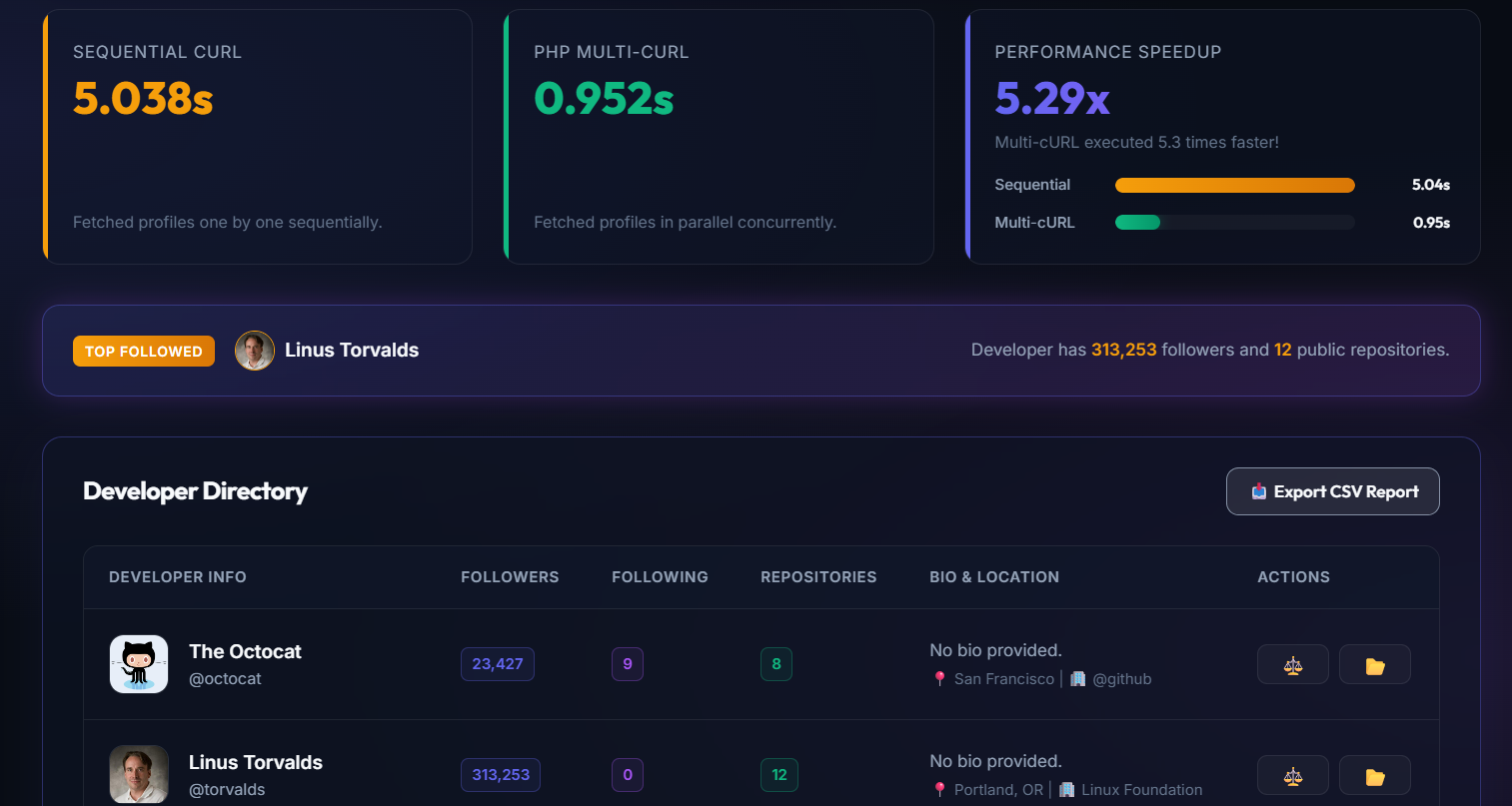
So, I built a small GitHub User Viewer.
The application accepts multiple GitHub usernames and fetches the same data using two different approaches:
Traditional sequential cURL
PHP Multi cURL
Both approaches request the same users from the same GitHub API under the same conditions. The only difference is how the requests are executed. That makes it easy to compare execution times and understand where concurrency actually helps.
You can see the results side by side below.
If you're interested in the implementation, you can explore the complete project on GitHub and experiment with it yourself.
Final Thoughts
Concurrency isn't about making APIs respond faster.
It's about making your application stop waiting unnecessarily.
The next time you're writing code that calls multiple APIs, don't immediately ask,
"How can I optimize this?"
Instead, ask a simpler question:
"Do these requests really need to wait for each other?"
If the answer is no, then concurrency—and tools like PHP Multi cURL—might be one of the simplest ways to improve your application's performance.
Comments (0)
Want to join the conversation?
Log in or create a ShubhamLabs account to leave a comment.